The AP Chemistry FRQ section is 105 minutes, 7 questions, and 50 points. It counts for half your composite score. And it is the section where the gap between a 3 and a 5 opens widest — not because the questions are harder than the multiple choice, but because most students do not understand how the section is scored.
Every year the College Board's Chief Reader, who oversees the scoring of hundreds of thousands of student responses, publishes a report that describes exactly how students performed on each question: what the highest-scoring responses did, what the lowest-scoring responses did, and the specific misconceptions that appeared most often. I have read this report every year for over a decade. It is genuinely useful in a way that most exam prep resources are not, because it comes from the people who actually score the exams.
This post pulls the most consistent and consequential findings from the 2023, 2024, and 2025 Chief Reader Reports and translates them into actionable strategy. Not general tips. The specific things that cost students points, year after year, and what the rubric is actually looking for instead.[1][2][3]
How the FRQ Section Is Actually Scored
Before getting into specific errors, it helps to understand the scoring structure. Each FRQ is broken into parts labeled (a), (b), (c), and so on. Each part is worth one or more points. Those points are awarded independently — meaning if you get part (a) wrong, you can still earn full credit on parts (b) through (d). There is no penalty for attempting a part incorrectly, and partial credit accumulates across the entire question.
This has two important implications. First, never leave any part blank. A response that contains a correct setup but an arithmetic error will often earn partial credit. A blank response earns zero. Second, a wrong answer in an early part does not disqualify your later work. If you use an incorrect value from part (a) in a calculation in part (c), but your part (c) setup and work are correct relative to the value you used, you can still earn the point — this is called error carried forward, and the rubric explicitly allows for it.
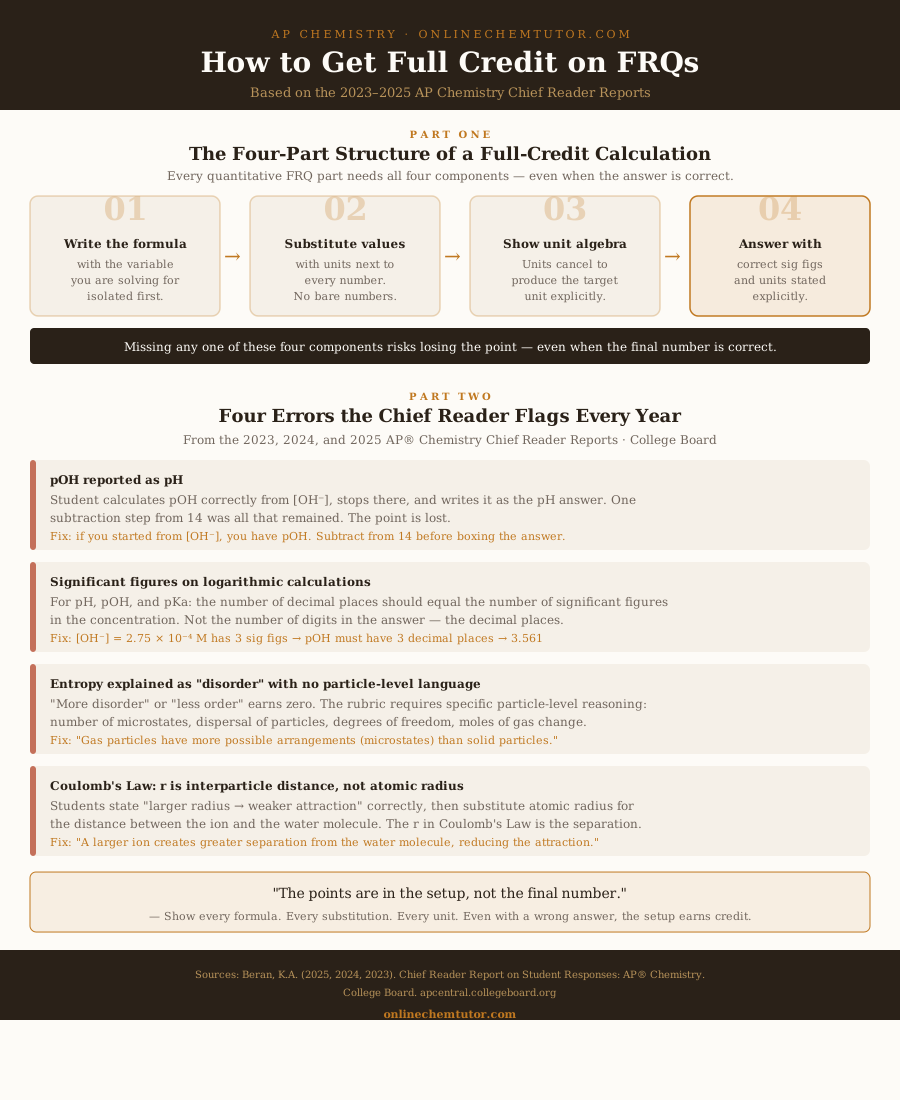
The points are in the setup, not the final number. Show every formula. Show every substitution. Show every unit. Even if your arithmetic is wrong, the setup earns credit.
The Four Things That Cost Students the Most Points
1. Reporting pOH When the Question Asked for pH
This is the single most consistent calculation error across the 2023, 2024, and 2025 reports. A student sets up the problem correctly, calculates pOH from the hydroxide ion concentration, and stops there — reporting that value as pH. One subtraction step from 14 would have given them the right answer. It does not happen, and the point is lost.
The 2025 Chief Reader Report names it explicitly: "Using the hydroxide ion concentration to calculate what is actually pOH, but stopping there and calling that answer pH."[1] This happens most often in questions involving basic solutions — sodium hydroxide, ammonia, buffers above pH 7. The check to build as an automatic habit: before boxing any pH answer, ask whether you started from [H⁺] or [OH⁻]. If you started from hydroxide, you calculated pOH first, and you need to subtract from 14 to get pH.
2. Significant Figures — Every Single Time
Significant figures errors appear in every Chief Reader Report, across every question type. The 2025 report addresses them directly for calorimetry calculations: most students in that question calculated the heat correctly using q = mcΔT, but failed to report the answer to the correct number of significant figures and lost the point.[1]
The rule that trips students up most: for logarithmic calculations like pH, pOH, and pKa, the number of decimal places in the answer should equal the number of significant figures in the concentration you started with. Not the number of digits in the answer — the number of decimal places. A concentration given as 2.75 × 10⁻⁴ M has three significant figures, so the calculated pOH should have three decimal places. This is not a style preference — it is a required part of a complete response, and the rubric treats it as its own point.
3. Coulomb's Law: r Is the Distance Between Two Charges, Not the Radius of One Atom
This misconception appears in questions about ion-dipole interactions, ionic bond strength, and hydration energy — anywhere Coulomb's Law is applied to compare attractions between charged particles and polar molecules. Students who have memorized that "larger ionic radius means weaker attraction" often state it correctly in words but then misapply the formula by substituting atomic radius for interionic distance. These are not the same thing.
The 2025 Chief Reader Report is precise about this: "the 'r' in the formula stands for the separation (distance) between those substances, not the 'radius' of just one of the substances. This misconception was observed many times."[1] A larger ion creates greater separation from the water molecule it is interacting with — that increased separation is what reduces the attraction. The radius is relevant only because it determines that separation distance. Getting the conceptual chain right matters because the rubric wants the reasoning, not just the conclusion.
4. Entropy Justifications: "Disorder" Is Not Enough
When an FRQ asks students to explain a change in entropy, vague language consistently fails to earn the point. "Because there is more disorder" earns zero. "Because the products have more disorder than the reactants" earns zero. The 2025 report identifies the specific error: "Using a 'less disorder/more order' justification without including a particle-level discussion of the reaction species."[1]
The rubric wants specific particle-level language: dispersal of energy, number of microstates, change in moles of gas, degrees of freedom, or number of possible particle arrangements. A complete response looks like: "Because gas particles are more dispersed and have more possible arrangements (microstates) than solid particles, the entropy decreases as the gaseous reactants convert to the solid product." That language — specific, particle-level, tied to the actual species in the reaction — is what earns the point. Practice writing entropy justifications this way until it becomes the default.
The FRQ Question Types and What Each One Requires
The seven FRQ questions divide into types, and each type has specific requirements the rubric consistently rewards:
| Question type | What it tests | What earns full credit |
|---|---|---|
| Quantitative / calculation | Stoichiometry, equilibrium, thermochemistry, kinetics, electrochemistry | Formula written, values substituted with units, unit algebra shown, answer with correct sig figs and units |
| Explain / justify | IMFs, Coulomb's law, Le Châtelier, entropy, Gibbs free energy | Named principle + specific particle-level application to the scenario in the question. "Because" statements with chemical evidence. |
| Particulate diagram | Solutions, gas mixtures, phase transitions, equilibrium | Correct particle ratios, ions labeled with charges, relative atom sizes accurate, species correctly identified |
| Lab / experimental design | Error analysis, data interpretation, procedure design | Specific measurements named, controlled variables stated, data cited from the question (not vague references to "the graph") |
| Graphing / titration curves | Acid-base titrations, kinetics plots, equilibrium | Half-equivalence point correctly identified (pH = pKa there), axes labeled, equivalence point distinguished from half-equivalence point |
Three More Patterns Worth Naming
The Dilution Formula Trap
In M₁V₁ = M₂V₂, V₂ is the total final volume after dilution — not the volume of water you added. The 2025 report documents this directly: many students used the volume of added water instead of the total diluted volume in part D of Question 1, producing answers that were off by a significant factor.[1] Before substituting into the dilution formula, confirm: is this the total volume in the new solution, or the volume that was poured in? They are only the same when you dilute to exactly double the original volume.
Titration Curves: The Half-Equivalence Point
Students consistently confuse the equivalence point and the half-equivalence point on weak acid-strong base titration curves. They are not the same location, and they are not the same pH. The equivalence point is where all the weak acid has been neutralized — the pH at that point depends on the conjugate base concentration. The half-equivalence point is halfway to the equivalence point — this is where pH equals pKa for the weak acid, and where the Henderson-Hasselbalch equation simplifies to its cleanest form because [A⁻] = [HA]. The 2025 report lists "not realizing that pH = pKa at the half-equivalence point" as a common error on Question 2.[1] Drawing the curve from memory and marking both points before doing any calculation forces this distinction to be explicit.
Q vs. K: Understand It, Don't Memorize It
Students who memorize "if Q < K, the reaction shifts right" without understanding why consistently misapply it when the scenario changes. The 2025 report addresses this directly: "While this may work generally, it does not help students understand the chemical principles governing the direction of shift."[1] The reasoning: Q compares the current ratio of products to reactants. K is the ratio at equilibrium. If Q is less than K, the current numerator (products) is too small — the system must produce more products to reach equilibrium, so it shifts right. Working through this logic each time, rather than retrieving the mnemonic, means the reasoning holds up in novel contexts where the mnemonic's surface pattern breaks.
What a Full-Credit Response Actually Looks Like
For any quantitative part of an FRQ, a full-credit response has four components: the formula written out with the variable you are solving for isolated, the substitution with the given values including their units, the unit algebra carried through to the final unit, and the numerical answer with correct significant figures and units stated explicitly. Skipping any of these steps — even when the final answer is correct — risks losing the setup point if the number is wrong.
For any explain or justify part, a full-credit response names the chemical principle (Le Châtelier's principle, Coulomb's law, London dispersion forces, the second law of thermodynamics) and then applies it specifically to the scenario described in the question, using the actual species and values from the problem. A generic statement of the principle earns zero. A specific application of it to this question earns the point.
The pattern that separates high-scoring responses from mid-scoring responses is not that the high scorers knew more chemistry. In most cases they knew the same chemistry. What they did differently was communicate it in the way the rubric recognizes: named, specific, particle-level, with units carried through and every step of the reasoning shown.
Write your reasoning like you are explaining it to someone who cannot see your scratch work. Because on exam day, you are.
How to Practice This
The most effective FRQ practice uses real released questions with real scoring rubrics — not practice problems from review books, which often accept vague language that the actual rubric would not. The College Board releases several years of FRQs with full scoring guidelines at apcentral.collegeboard.org. For each practice response, score it yourself against the rubric before looking at the answer — this forces you to confront the exact language the rubric requires and builds the habit of writing to it.
For calculation questions: work the problem, then cover your answer and check whether each of the four components (formula, substitution with units, unit algebra, final answer with sig figs) is present. If any one of them is missing, the response would lose that point on the real exam — even if the number is right.
For explain and justify questions: read your response and ask whether it names a specific principle and applies it to the specific species in this problem. If it could have been written about a different question without changing a word, it is too vague to earn the point.
This kind of practice is slow at first. It speeds up as the habits become automatic — and by the time the exam arrives, the response format that earns points is the only one that comes naturally. That is the goal.
If you are working through this with a student in AP Chemistry and want someone who knows exactly what the rubric expects — and who reads the Chief Reader Report every year — the free 15-minute intro call is the place to start.

References
- Beran, K. A. (2025). Chief Reader Report on Student Responses: 2025 AP® Chemistry Free-Response Questions. College Board. https://apcentral.collegeboard.org/media/pdf/ap25-cr-report-chemistry.pdf
- Beran, K. A. (2024). Chief Reader Report on Student Responses: 2024 AP® Chemistry Free-Response Questions. College Board. https://apcentral.collegeboard.org/media/pdf/ap24-cr-report-chemistry.pdf
- Beran, K. A. (2023). Chief Reader Report on Student Responses: 2023 AP® Chemistry Free-Response Questions. College Board. https://apcentral.collegeboard.org/media/pdf/ap23-cr-report-chemistry.pdf