Every year I watch students spend equal time on every AP Chemistry unit. Equal time on atomic structure and equal time on intermolecular forces. Equal time on electrochemistry and equal time on acids and bases. They feel thorough. They feel prepared.
Then they sit the exam and discover that Unit 3 — intermolecular forces and properties — showed up as nearly a fifth of their Multiple Choice section. That Unit 8 — acids and bases — followed close behind. And that the five units they spread themselves thin across barely moved the needle.
This guide is about fixing that. Not with a motivational pep talk. With the actual numbers.
What the AP Chemistry Exam Actually Looks Like
The exam is 3 hours and 15 minutes, split into two sections of equal weight:
- Section I: 60 Multiple-Choice Questions (MCQ) — 90 minutes, no calculator
- Section II: 7 Free-Response Questions (FRQ) — 105 minutes, calculator allowed
- 3 Long FRQs (10 points each)
- 4 Short FRQs (4 points each)
Each section contributes 50 points toward a composite score of 100. A 5 requires approximately 72 composite points — meaning you need to earn about 45 of 60 MCQ points and 27 of 50 FRQ points. According to the 2025 official score distribution, only 17.8% of students who took the exam scored a 5. About 46% scored a 3 or below.
That gap between "I studied a lot" and "I scored a 5" is almost always about strategy, not effort.
The 9 Units — and Why They Are Not Equal
The College Board publishes the exam weighting for each unit in its Course and Exam Description (CED). Most students never look at this document. That's a structural disadvantage they're handing themselves for free.
| Unit | Topic | MCQ Weight | Priority |
|---|---|---|---|
| 3 | Intermolecular Forces & Properties | 18–22% | 🔴 Highest |
| 8 | Acids & Bases | 11–15% | 🔴 Very High |
| 1 | Atomic Structure & Properties | 7–9% | 🟡 High (foundation) |
| 4 | Chemical Reactions | 7–9% | 🟡 High |
| 5 | Kinetics | 7–9% | 🟡 High (FRQ target) |
| 6 | Thermochemistry | 7–9% | 🟡 Medium-High |
| 7 | Equilibrium | 7–9% | 🟡 High |
| 9 | Applications of Thermodynamics | 7–9% | 🟡 Medium-High |
| 2 | Molecular & Ionic Compound Structure | 7–9% | 🟢 Medium |
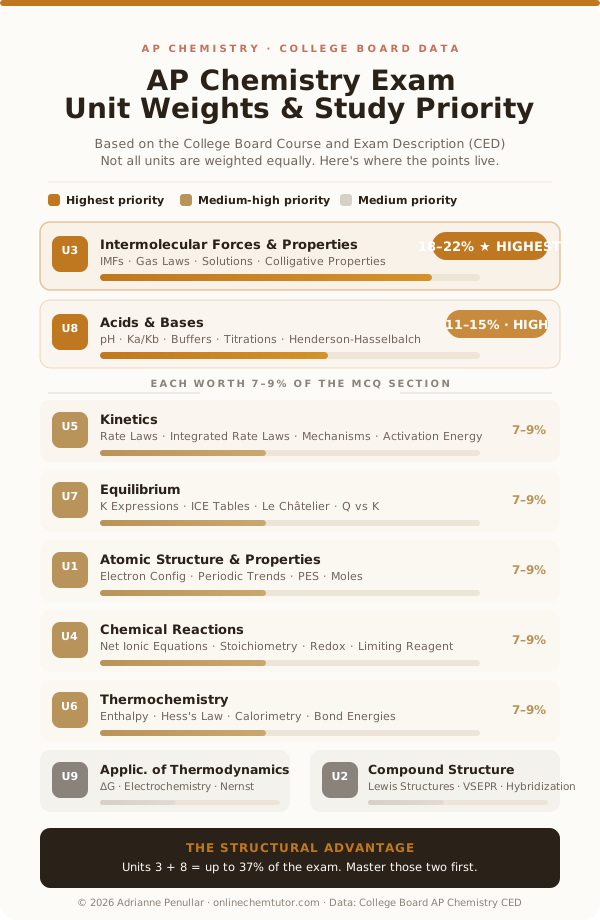
Units 3 and 8 together account for roughly 30–37% of the MCQ section. Add Units 5 and 7 and you're approaching 50–55% of the entire exam concentrated in four units. A student who masters those four units deeply, and maintains working knowledge of the other five, is already close to a 4 before the FRQ section starts.
Unit 3: Intermolecular Forces — Your Highest-Return Investment
Unit 3 covers intermolecular forces (IMFs), the kinetic molecular theory, gas laws, solutions, and colligative properties. At 18–22% of the MCQ section, it is by far the heaviest single unit on the exam.
What makes it especially valuable: IMF reasoning bleeds into nearly every other unit. When you explain why a substance has a high boiling point, why two liquids mix, why a gas deviates from ideal behavior, or why a protein folds — you're using Unit 3 logic. Mastering IMFs doesn't just earn points in Unit 3. It helps you reason through questions tagged to Units 1, 2, 6, and 7 as well.
The key hierarchy to have cold: London dispersion forces < dipole-dipole < hydrogen bonding, and the specific requirement for true hydrogen bonding — an H directly bonded to N, O, or F (not just near those atoms). The 2025 Chief Reader Report flagged students writing vague IMF justifications as a recurring FRQ issue. "Because it has stronger bonds" earns zero points. "Because hydrogen bonding requires a hydrogen atom directly bonded to a fluorine, oxygen, or nitrogen atom, and compound X satisfies this requirement while compound Y does not" earns full credit.
Unit 8: Acids and Bases — The Most Technically Demanding Unit
Unit 8 is where students most often underestimate the depth of what they need to know. pH, pOH, Ka, Kb, buffer solutions, Henderson-Hasselbalch, and titration curves are all in play — and they connect back to Unit 7 (equilibrium) in ways that trip students who learned each topic in isolation.
The single most common calculation error I see in this unit, confirmed in both the 2024 and 2025 Chief Reader Reports: students correctly calculate pOH and then report it as their final answer for pH. They forget to subtract from 14. It's a one-step arithmetic move, and it costs a point. Build the habit of always checking whether the question asks for pH or pOH before you box your answer.
Titration curves deserve their own practice. Students consistently confuse the half-equivalence point (where pH = pKa) with the equivalence point. They are not the same location on the curve. Drawing and interpreting titration curves for weak acid/strong base and weak base/strong acid titrations — including buffer regions and particle-level diagrams — appears nearly every year in the FRQ section.
The FRQ Section: Where Points Are Actually Won and Lost
The FRQ section is where the gap between a 3 and a 5 opens widest. Not because the questions are harder — but because students don't know the rules of how FRQs are scored.
Show every step of every calculation. Every time.
AP Chemistry FRQs award partial credit for correct setup, even when the final numerical answer is wrong. If you write only the answer — no formula, no substitution, no units — and that answer is wrong, you receive zero points for the entire calculation. If you write the setup correctly and make an arithmetic error in the final step, you often still receive most of the available credit.
The pattern: write the formula, substitute with labeled values and units, show the arithmetic, state the answer with correct significant figures and units. Never skip a step to save time. The calculation steps are where the points live, not the number at the end.
Significant figures and units are not optional.
The 2023 and 2024 Chief Reader Reports both list significant figure errors and missing units as among the most common and preventable ways students lose points. These are not minor deductions for style — they are required parts of a complete response. The number of decimal places in a calculated pH should match the significant figures in the concentration you started with. Practice this until it's automatic.
For "explain" and "justify" prompts: name the principle, always.
When an FRQ asks you to explain or justify, vague language does not earn credit. "Because it's more stable" earns zero. "Because the system shifts toward the products to relieve the increased concentration of the reactant, consistent with Le Châtelier's principle" earns the point. The rubric is looking for a specific chemical principle, named explicitly, applied correctly to the scenario in the question. If you can't name the principle, you probably haven't fully learned it yet — and that's a signal to go back.
Particle diagrams: show scale, show ratios, label everything.
Particle-level diagrams appear almost every year, often in the context of solutions, gas mixtures, or phase transitions. Common errors cited in Chief Reader Reports include drawing macroscopic representations instead of submicroscopic particles, incorrect particle ratios, and not labeling species clearly. When drawing particles: larger atoms should look larger, ions should be labeled with charges, and the ratio of particles in the diagram should match the chemistry of the scenario.
The Mistakes the College Board Keeps Seeing (So You Don't Have To)
Every year, the College Board's Chief Reader publishes a detailed breakdown of exactly where students lost points. I read these every year because they're the closest thing to a cheat sheet the AP program accidentally publishes. Here are the patterns that appear across the 2023, 2024, and 2025 reports:
- Coulomb's Law confusion: In Coulomb's Law applied to atomic interactions, r is the distance between two charges — not the radius of one atom. Students who apply Coulomb's Law to compare bond strengths or ion attractions consistently lose points by substituting atomic radius for interionic distance.
- The dilution formula trap: In M₁V₁ = M₂V₂, V₂ is the total final volume after dilution — not the volume of water you added. Substituting the added water volume is one of the most common calculation setup errors in Unit 4.
- Q vs. K direction of shift: Students who memorize "if Q < K, the reaction shifts right" without understanding why consistently apply this incorrectly when the scenario changes. Work through the reasoning — if Q is less than K, the numerator (products) is too small relative to the denominator (reactants), so the system shifts to produce more products. Own the concept, not the mnemonic.
- Temperature and exothermic equilibrium: For exothermic reactions, increasing temperature shifts the equilibrium toward reactants and decreases K. Students routinely predict the direction of shift correctly but then state K increases — a contradiction that costs points.
- Entropy language: When explaining entropy changes, "disorder" is too vague and often not accepted. The rubric wants specific particle-level language: dispersal of energy, number of microstates, change in moles of gas, or change in degrees of freedom. Practice writing entropy justifications with concrete particle-level reasoning.
- Electron configuration before ionization: A very common error in Unit 1: when writing the electron configuration of a transition metal ion, students remove electrons from the 3d subshell before 4s. This is wrong. 4s electrons are always removed first when forming a cation, even though they appear last when filling.
A Practical Time Allocation Framework
If you have 8 weeks before the exam and you're currently scoring around a 3 or low 4, here is a unit-weighted time allocation that mirrors the exam structure:
| Phase | Focus | Why |
|---|---|---|
| Week 1–2 | Units 3 and 8 — deep mastery | Highest combined exam weight; FRQ targets; conceptually dense |
| Week 3–4 | Units 7 and 5 — calculation fluency | ICE tables, equilibrium expressions, rate laws, integrated rate laws |
| Week 5 | Units 1, 4, and 6 — fill gaps | Foundational; conceptually familiar but technically tricky under time pressure |
| Week 6 | Units 2 and 9 — working knowledge | Lower MCQ weight; still FRQ-eligible; don't ignore, just scope tightly |
| Week 7 | Full practice exam (timed) | Simulate real conditions; identify gaps by unit |
| Week 8 | FRQ deep practice + error review | Use actual released FRQs with scoring rubrics; mark against the rubric yourself |
The most important thing this table is trying to say: Units 3 and 8 earn the first two weeks. Not because they're the hardest (though Unit 8 often is), but because the exam reward is highest there. Every additional hour you put into mastering intermolecular forces and acid-base chemistry returns more points per hour than the same time split evenly across all nine units.
On the MCQ Section: One Pacing Rule That Matters
Ninety minutes for 60 questions is 90 seconds per question on average. In practice, some questions — a periodic trend comparison, a Lewis structure identification — will take under 45 seconds. Others — a multi-step equilibrium calculation with a data set — will take two to three minutes.
The discipline that separates high scorers: if you haven't selected an answer within 90 seconds on a question, mark it and move on. Return only if you have time after finishing the section. Students who stay on hard questions bleed time from the easier ones they would have gotten right with 30 more seconds. The fastest path to more MCQ points is protecting the questions you already know how to do.
One content note for no-calculator MCQ: you will not be computing full equilibrium calculations in your head. MCQ questions that touch on equilibrium, kinetics, or thermochemistry in Section I are testing conceptual understanding — direction of shift, relative magnitudes, qualitative reasoning — not precise calculation. Don't panic when you see those unit topics without a calculator. The question is asking for reasoning, not arithmetic.
The Honest Bottom Line
The AP Chemistry exam is hard. The 2025 pass rate (scores of 3 or higher) was 77.9% — which sounds encouraging until you look at the full picture: only 17.8% scored a 5, and 22.1% didn't pass at all. The students in the 5 range are not necessarily smarter. They studied more strategically. They understood which units the exam rewards most. They practiced FRQ setup until it was automatic. They read their own wrong answers and figured out what they actually misunderstood.
Chemistry is learnable. All of it. But it is not learnable in the final week before the exam — and it is not learnable by re-reading notes passively. Work problems. Check your setup before you check your answer. Write your reasoning out loud in FRQ practice the same way you'd have to on exam day.
If you want to work through this with someone who teaches this material every day — and knows exactly what the exam is looking for — that's what I do. The free 15-minute call is the place to start.