Here is something I've said in some version to nearly every student I've worked with:
"Don't tell me the answer. Tell me how you knew which direction to go."
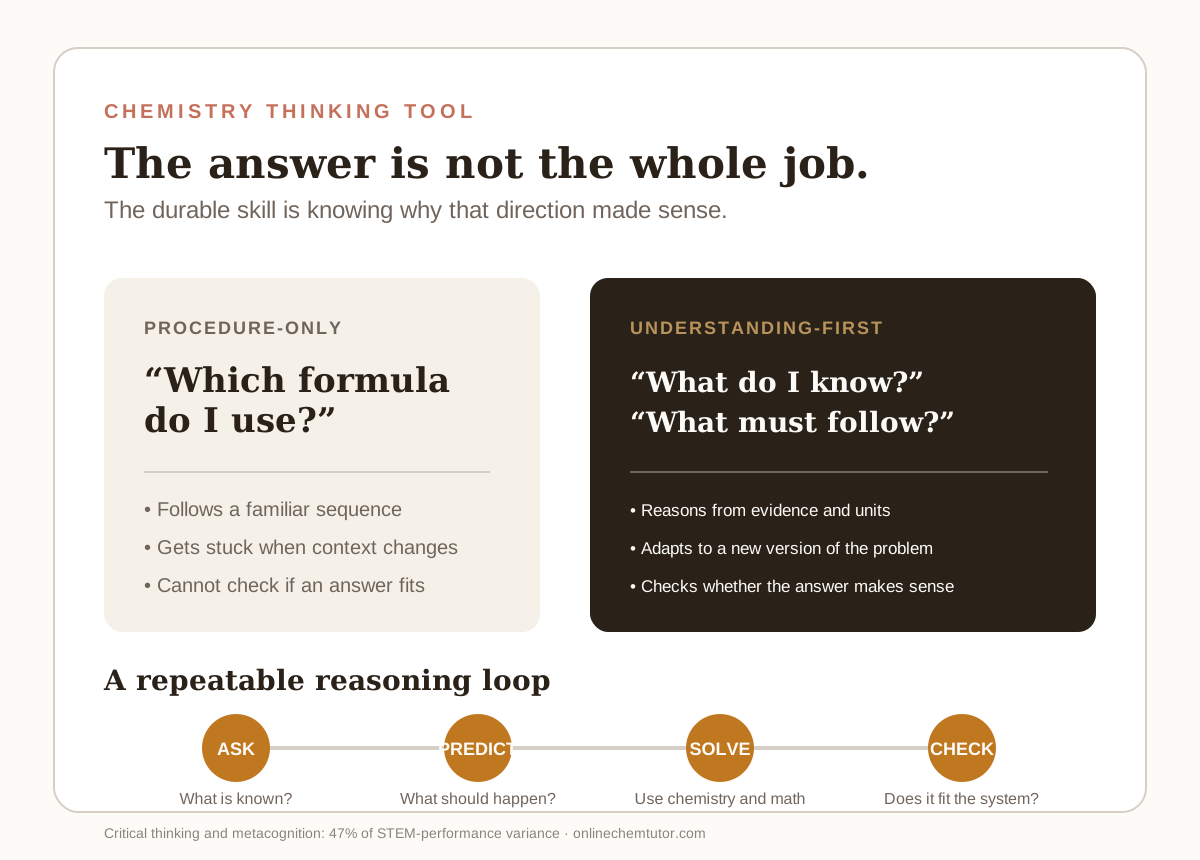
That question separates two very different kinds of chemistry students. The first kind has memorized what to do. They can set up a dimensional analysis problem because they followed the steps. They can find pH because they remembered to use −log[H⁺]. They look competent right up until the question changes slightly — a different context, a flipped unit, a problem they haven't seen before — and then the algorithm fails them because it was never really theirs.
The second kind has figured out why the steps work. They didn't memorize that pH = −log[H⁺]. They understand that pH is a compressed way of expressing a very small concentration, that the negative sign is what makes higher concentration produce a lower number, and that log is just a way of talking about powers of ten. When the question changes, they adapt — because they're not retrieving a procedure, they're reasoning.
Everything I do in coaching is pointed at building the second kind of student. Not because it's a nicer way to learn chemistry, but because the research on learning is unambiguous about which approach produces durable understanding — and because the thinking skills that make someone good at chemistry are the same skills that make someone a careful, rigorous thinker in every other domain of their life.
What Constructivism Actually Means in Practice
There is a well-established body of research in science education called constructivism. Its central claim is straightforward: knowledge that learners construct for themselves — through guided investigation, reasoning from evidence, and connecting new ideas to what they already know — is retained longer and transfers more readily to new situations than knowledge that was delivered to them.[1]
Driver and Bell (1986), in foundational work on constructivist approaches to science education, described learning not as "the passive reception of given knowledge" but as an active process in which the learner "is seen to be pro-active" — interpreting new information through the lens of what they already understand, and building meaning from that encounter.[2] Taber (2009), reviewing three decades of constructivist research in chemistry, summarized the practical implication for teachers: the curriculum should be "a programme of activities that encourage learners to (re)construct scientific knowledge," with the teacher functioning as a facilitator rather than a transmitter.[3]
In the classroom, constructivism is sometimes interpreted as a loose, student-led approach where anything goes. That's a misreading. What the research actually supports is guided inquiry: structured enough that students are working toward real chemical understanding, open enough that they are arriving at conclusions through their own reasoning rather than being told what to conclude.
In a coaching session, this looks like asking a student: "You got the right answer on that stoichiometry problem. Now tell me — if I doubled the amount of the limiting reagent, what would happen to the yield? Don't calculate it. Just reason through it." A student who truly understands stoichiometry answers immediately. A student who memorized the procedure has to go back to the formula, which isn't the right tool for that question.
A Concrete Example: Deriving Units Instead of Memorizing Formulas
One of the things I push hardest on early in coaching is dimensional analysis — not as a formula-following exercise, but as a reasoning framework. Most students are taught a procedure: set up the conversion, cancel the units, multiply through. It works for textbook problems. It breaks down when the conversion has three steps, or when the units are unfamiliar, or when the student forgets which way to flip the ratio.
What I want students to see is that dimensional analysis is not a procedure — it's a way of letting the units themselves tell you whether your logic is right. If your units don't cancel to what you want, you've made a reasoning error somewhere. The units are not decoration. They are a built-in error-checking system.
Here's what this looks like in practice. Suppose a student is asked to convert 45 miles per hour into meters per second. Most students reach for a formula sheet or a calculator right away. I stop them. Instead I ask: "What are you starting with? What do you want to end up with? What relationships do you know that connect those units?" We build the conversion chain together — not from a template, but from first principles. Miles to kilometers. Kilometers to meters. Hours to minutes to seconds. Each step is a ratio that equals one; we're just choosing which form of one to multiply by.
When a student builds that chain themselves, two things happen. First, they stop needing to memorize which formula to use — because they can derive the path. Second, they start noticing that this same logic works everywhere: for molar conversions, for concentration calculations, for thermochemistry. Dimensional analysis is not one topic in chemistry. It's the structural spine of quantitative reasoning across the entire course.
The same principle applies to scientific notation. Students who reach for a calculator for every power-of-ten operation are hiding a gap in number sense that will cause problems throughout the course. 10⁻³ is one-thousandth. 10⁶ is one million. Moving a decimal point three places to the right multiplies by one thousand. These aren't facts to memorize — they're relationships to understand. A student who understands them can estimate the answer to a pH problem before calculating it, which means they know immediately when they've made a keypress error. A student who doesn't understand them accepts whatever the calculator returns.
The Research on Critical Thinking in STEM
Paz-Baruch and colleagues (2024), in a study examining self-regulated learning and achievement in STEM disciplines, found that critical thinking strategies and metacognition — students' ability to monitor and regulate their own thinking — were significant mediators between self-efficacy and academic achievement, together accounting for 47% of the variance in STEM performance among high school students.[4] That is a large number. It means that nearly half of what determines a student's outcome in a STEM course is not their raw aptitude, but the quality of how they think about their own thinking.
Metacognition — the ability to step back from a problem and ask do I actually understand this, or do I just recognize the pattern? — is precisely what the memorization approach to chemistry undermines. A student who has memorized twenty problem types can recognize patterns efficiently. But recognition is not understanding. The AP Chemistry exam, and nearly every college chemistry exam worth its name, is specifically designed to distinguish the two. Novel contexts, unfamiliar combinations of topics, questions that require reasoning from principle — these are not trick questions. They are tests of whether the student can think with the chemistry, or only execute it.
Dunlosky and colleagues (2013), in their comprehensive review of learning strategies in Psychological Science in the Public Interest, found that the two highest-utility study techniques were distributed practice and retrieval practice — both of which require active engagement with the material, not passive re-reading of procedures.[5] Retrieval practice, in particular, is most effective when the retrieval requires reconstructing the reasoning, not just the answer. "What is the pH of this solution?" is a retrieval question. "Why is the pH of this solution higher than you'd expect from a strong acid of the same concentration, and what does that tell you about the species present?" is a thinking question. The second one builds the kind of understanding that survives the next exam.
Why This Matters Beyond Chemistry
I'll be direct about something. The reason I coach chemistry the way I do is not primarily because it produces better exam scores — though it does. It's because the thinking skills involved in working through chemistry from first principles are transferable.
A student who has learned to ask "how do I know this?" and "what would change if one of these variables were different?" and "does this answer make sense given what I know about the scale of things?" is not just a better chemistry student. They are a more rigorous thinker. They evaluate claims differently. They notice when an argument is based on pattern-matching rather than reasoning. They are less likely to accept a conclusion — in any domain — simply because it came from an authority and the steps looked plausible.
This is not a new idea. Dewey (1916) argued that education's purpose was not the transmission of facts but the development of the capacity for reflective thought — the ability to "transform a situation in which there is experienced obscurity, doubt, conflict, disturbance of some sort, into a situation that is clear, coherent, settled, harmonious."[6] Chemistry, with its demand for precision, its insistence on evidence, and its resistance to hand-waving, is an unusually good vehicle for building that capacity.
The student who learns to derive a unit conversion instead of memorizing one is also learning to trust their own reasoning. The student who learns to check whether their answer makes physical sense before accepting it is also learning to hold conclusions to a standard. Those habits don't stay inside the chemistry classroom.
What This Looks Like in a Coaching Session
In practice, here's how this philosophy shows up in the sessions I run:
- I ask before I explain. Before I address a misunderstanding, I ask the student to walk me through their reasoning. I want to know where the thinking went sideways, not just where the answer went wrong. The wrong answer is a symptom. The reasoning gap is the actual problem.
- I push for estimation before calculation. Before a student touches a calculator, I want them to tell me approximately what range the answer should be in. For a pH problem: is this going to be above or below 7? Closer to 2 or closer to 6? This forces engagement with the meaning of the numbers before the arithmetic begins.
- I ask "what would change if…" constantly. Once a student has solved a problem correctly, that's not the end of the session. I change a variable. I flip the direction. I ask what happens to the equilibrium if we increase the pressure, if we add a common ion, if we raise the temperature for an exothermic reaction. The original problem was practice. The follow-up questions are understanding.
- I make students write the reasoning, not just the calculation. For any FRQ-style question, I require a written explanation alongside the math. Not because AP Chemistry requires it — though it does — but because writing the reasoning forces the student to find out whether they actually have one.
- I don't rescue immediately. When a student is stuck, my first response is a question, not an explanation. "What do you know for certain about this system?" "What are the possible reasons this value could be larger than you expected?" The discomfort of working through confusion is not a problem to be removed. It is the learning.
The Honest Tradeoff
I want to be transparent about one thing. This approach is slower at first than procedure-drilling. A student who memorizes the acid-base calculation template can execute pH problems faster in week three than a student who is building the underlying understanding from scratch.
But by week eight, the understanding-first student can handle a novel acid-base problem they've never seen. They can identify which calculation applies, set it up from reasoning, and check whether the answer makes sense. The template-memorizer reaches week eight with a collection of recipes that doesn't include this one.
General chemistry and AP Chemistry are cumulative courses. The concepts in week three show up in week eight, which show up on the final exam, which shows up in the prerequisite for the next course. Understanding compounds. Memorization doesn't. That compounding effect is the reason the approach matters — and the reason that semester-long coaching produces different results than a cram session the week before the exam.
If your student is in AP or college chemistry and you want them to actually understand what they're doing — not just get through the semester — the free 15-minute call is the place to start. I'll be straightforward about whether we're a good fit.
References
- Von Glasersfeld, E. (1995). Radical constructivism: A way of knowing and learning. Falmer Press. In Taber (2009), reviewed as part of three decades of constructivist research in science education.
- Driver, R., & Bell, B. (1986). Students' thinking and the learning of science: A constructivist view. School Science Review, 67(240), 443–456. Cited in Taber, K. S. (2009). Constructivism and the crisis in U.S. science education: An essay review. Education Review, 12(12).
- Taber, K. S. (2014). Constructing active learning in chemistry: Concepts, cognition and conceptions. In I. Devetak & S. A. Glažar (Eds.), Learning with understanding in the chemistry classroom (pp. 1–22). Springer. https://doi.org/10.1007/978-94-007-4366-3_1
- Paz-Baruch, N. (2024). The impact of self-efficacy and self-regulated learning strategies on students' achievements in STEM disciplines. Educational Research and Evaluation, 30(3–4). https://doi.org/10.1080/13803611.2024.2401409
- Dunlosky, J., Rawson, K. A., Marsh, E. J., Nathan, M. J., & Willingham, D. T. (2013). Improving students' learning with effective study techniques. Psychological Science in the Public Interest, 14(1), 4–58. https://doi.org/10.1177/1529100612453266
- Dewey, J. (1916). Democracy and education: An introduction to the philosophy of education. Macmillan. (Public domain; available via Project Gutenberg.)