Organic chemistry has a particular cruelty to it. A student can spend hours on homework, follow every example, and feel genuinely prepared — and then sit down for the midterm and discover that the questions are asking for something they never actually practiced: reasoning.
I have coached students through organic chemistry for a long time. And the pattern I keep seeing is not students who did not study. It is students who studied the wrong thing — or more precisely, students who practiced procedures without building the mental models underneath them. The gap is invisible during homework and completely exposed on exams.
The five concepts below are where that gap shows up most often. None of them are obscure. All of them feel manageable right up until the question changes slightly and the procedure fails. I want to name each one specifically, explain what the actual misunderstanding is, and describe what it looks like to actually fix it — not just review it.
1. Curved Arrows: Moving Electrons, Not Atoms
Curved arrows are the grammar of organic chemistry. Every mechanism, every reaction step, every acid-base interaction is written using them. And yet research is very clear about how poorly most students actually understand what they mean.
Ferguson and Bodner (2008), in a study of students enrolled in second-year organic chemistry, found that many students used the arrow-pushing formalism in what they described as a "meaningless, mechanical manner" — following the visual pattern of arrows from examples without understanding that each arrow represents the movement of two electrons from a source of electron density to a sink.[1] They drew arrows that looked right but pointed in chemically impossible directions, because they were copying the shape of the notation, not the logic.
Flynn and colleagues (2017), analyzing student exam responses in a large-scale study, found that errors were not random — students made systematic errors that revealed specific misunderstandings about what arrows represent. One error type they identified: students would effectively "pick up" electrons from one atom and "set them down" on a different atom, as if electrons were objects being relocated rather than pairs moving through a defined path.[2] They also found that scores on problems asking students to draw arrows given the products were significantly higher than scores on problems asking students to draw products given the arrows — meaning students could mimic the notation better than they could use it to reason forward.
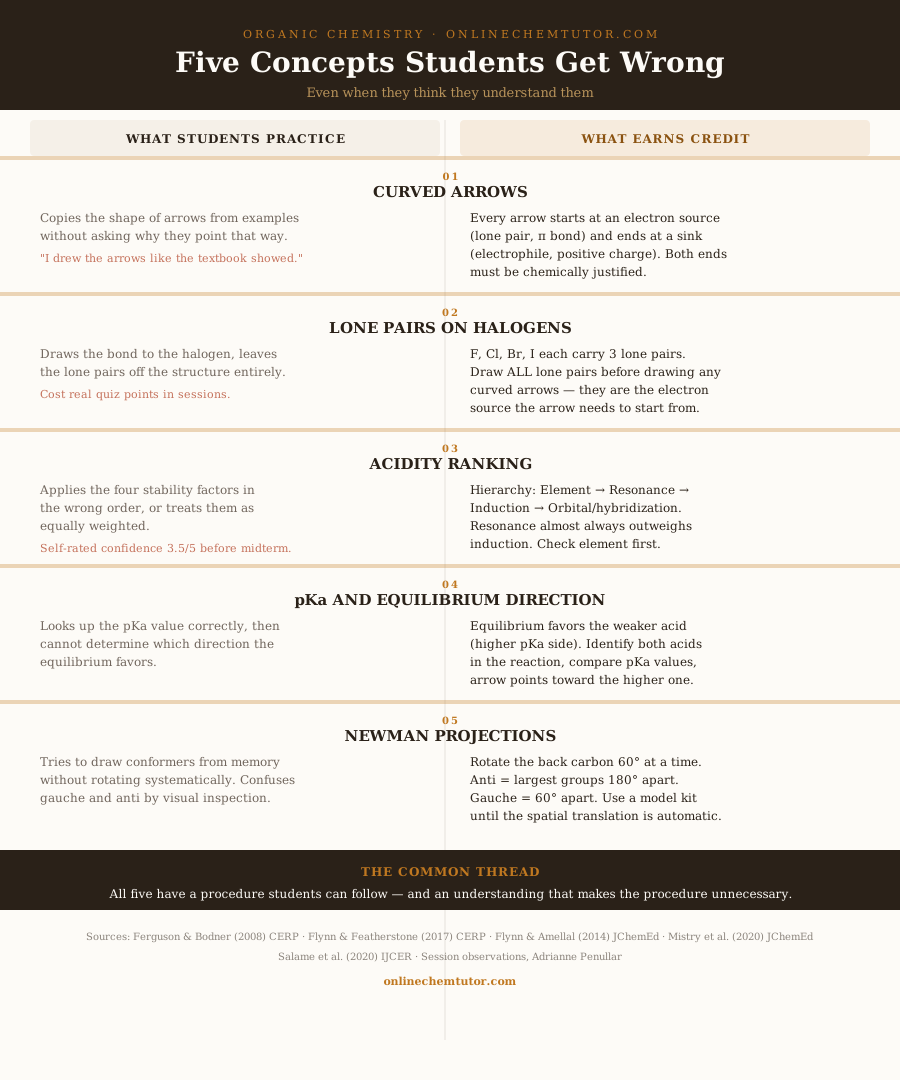
The fix is not more arrow practice. It is building the concept that a curved arrow starts where electrons are (a lone pair, a pi bond, a sigma bond) and ends where electrons are going (an electronegative atom, a positive charge, an empty orbital). Every arrow has a source and a destination, and both have to be chemically justified. Before drawing any arrow, the question to ask is: what is the electron source here, and what is pulling those electrons? If you cannot answer that, the arrow is a guess.
The arrow is not decoration. It is a claim about where electron density is moving and why. If you cannot justify both ends, you do not have a mechanism — you have a drawing.
A specific check that catches most errors: lone pairs on heteroatoms. Halogens, nitrogen, oxygen — any atom with lone pairs can act as an electron source in a mechanism. Students consistently omit lone pairs when drawing Lewis structures for these atoms, which means the electron source for their arrow simply does not exist on the page. Drawing in every lone pair before starting any mechanism forces you to account for what is actually available.
2. Lone Pairs: The Electrons Students Keep Forgetting to Draw
This one is so common it almost deserves its own category. Students learn to draw Lewis structures in general chemistry, feel confident about them, and then carry a specific blind spot into organic chemistry: they routinely omit lone pairs on halogens.
It costs points in two ways. First, a Lewis structure without lone pairs on a halogen is an incomplete structure — and instructors who require correct Lewis structure drawings for credit will mark it wrong. Second, and more consequentially, omitted lone pairs make it impossible to correctly identify that atom as a nucleophile, an electron-pair donor in a Lewis acid-base context, or a participant in resonance. The mechanism fails because the electrons that were supposed to be there are missing.
Fluorine has 3 lone pairs. Chlorine has 3 lone pairs. Bromine has 3 lone pairs. Iodine has 3 lone pairs. This does not change based on what molecule they are in. But students who learned to focus on bonds and formal charges in general chemistry never developed the habit of drawing lone pairs on every atom that has them — and in organic chemistry, that habit becomes essential.
The practical fix is a rule applied before any mechanism: draw all lone pairs first, before drawing any arrows. Not as an afterthought — as the first step. This forces you to see what electron density is actually available and prevents the most common version of the error, where an arrow starts at an atom that has no lone pairs drawn on it.
3. Acidity Ranking: Four Factors, in the Right Order
Ranking acids by strength is one of the first skills introduced in organic chemistry acid-base chemistry, and one of the most persistently misapplied ones. The reason is that acidity depends on the stability of the conjugate base — and conjugate base stability is determined by multiple factors that interact. Students who memorize the factors individually often apply them in the wrong order, or apply one factor when a more dominant one applies.
Flynn and Amellal (2014), in a study specifically examining students' use of pKa values in organic acid-base problems, found that students consistently struggled when the answer required estimating or comparing acid strength in contexts where the information was not directly available from a reference table — meaning they had learned to look up values, but not to reason about which structural features drive acidity.[3] Their results showed improvement in some areas after targeted instruction, but persistent difficulty in more complex comparative contexts.
The four factors that govern acidity — and the order in which to apply them — are:
| Factor | What it means | When it dominates |
|---|---|---|
| Element / electronegativity | More electronegative atoms stabilize negative charge better — O-H is more acidic than N-H, which is more acidic than C-H | Any time the acidic hydrogen is on a different element — check this first |
| Resonance | If the conjugate base can delocalize the negative charge across multiple atoms, it is more stable and the acid is stronger | Carboxylic acids vs. alcohols; phenols vs. cyclohexanol |
| Induction | Electronegative substituents on the molecule pull electron density away from the conjugate base, stabilizing it | Comparing acids with the same acidic atom but different substituents — halogenated acids vs. unsubstituted |
| Orbital / hybridization | sp carbons hold electrons closer to the nucleus than sp² or sp³; more s-character = more acidic C-H | Comparing terminal alkynes vs. alkenes vs. alkanes as carbon acids |
The most common error: applying induction when resonance should have been applied first, or treating all four factors as equally weighted when they have a clear hierarchy. Resonance almost always outweighs induction. A carboxylic acid is much stronger than an alcohol not because of electron-withdrawing groups but because the carboxylate anion delocalizes the negative charge across two oxygen atoms through resonance. Getting that reasoning wrong on an exam costs points even when the final answer ranking happens to be correct — because the rubric wants the right justification, not just the right order.
4. pKa and Equilibrium Direction: Knowing the Number Is Not Enough
Students learn pKa values, look them up in tables, and feel confident. Then an exam question asks them to determine which direction an acid-base equilibrium lies — and the confidence disappears.
The reason is that pKa is not just a number to memorize. It encodes a relationship: the lower the pKa, the stronger the acid, the more stable the conjugate base. And that relationship is what you use to determine equilibrium direction. The rule is: equilibrium favors the formation of the weaker acid and the weaker base. But applying that rule requires being able to look at two acids in a reaction and determine which one is stronger — which requires understanding what pKa means, not just where the numbers sit on a table.
The check that catches most errors on these problems: identify both acids in the reaction (one on each side of the equilibrium arrow), look up or estimate their pKa values, and confirm that the equilibrium arrow points toward the side with the higher pKa acid (the weaker acid). If it does not, the direction is wrong. This is not a shortcut — it is the actual logic the rule is based on. Students who memorize "equilibrium favors the weaker acid" without understanding why it is true will misapply it in any problem that requires even slightly different setup.
Closely related: the difference between a strong acid and a weak acid is not just a vocabulary distinction. The six strong acids fully dissociate — their conjugate bases are so stable that the reverse reaction essentially does not happen. Weak acids establish a true equilibrium. A student who can list the six strong acids but cannot explain what "fully dissociates" means at the molecular level does not actually understand the distinction, and that gap shows up whenever the exam asks for reasoning rather than recall.
5. Newman Projections: Seeing the Three-Dimensional Structure, Not Just Drawing the Symbol
Newman projections are one of the concepts students most commonly report as confusing — and the research supports why. The difficulty is genuinely spatial. Newman projections require translating a three-dimensional molecule into a two-dimensional representation by looking straight down a carbon-carbon bond, and then mentally rotating that molecule to generate different conformers and rank their stability.
Mistry, Singh, and Ridley (2020), studying students' ability to draw Newman projections and chair conformations, found that targeted spatial reasoning practice — specifically, the use of three-dimensional models to connect the physical molecule to its two-dimensional representation — produced significant improvements in students' ability to both draw and interpret Newman projections correctly.[4] The implication is direct: students who try to learn Newman projections purely from two-dimensional drawings on a page are missing the spatial translation step that makes the notation meaningful.
The specific errors that cost points most often:
- Forgetting the 60-degree rotation protocol. To go from one conformer to the next, the back carbon rotates by 60 degrees while the front carbon stays fixed. Students who skip this step and try to draw conformers from memory without rotating systematically produce incorrect structures — groups end up in the wrong positions, and the stability ranking that follows is wrong because it is based on a structure that does not exist.
- Confusing gauche and anti by inspection. Anti means the two largest groups are 180 degrees apart — directly opposite. Gauche means they are 60 degrees apart. Students who have not drilled this enough try to identify conformer type by the look of the drawing rather than measuring the dihedral angle, and they get it wrong on structures with multiple substituents where the drawing gets crowded.
- Ranking stability without accounting for all interactions. The most stable conformer minimizes all steric strain, not just the strain from the largest groups. Students who only consider the two largest substituents miss gauche interactions involving smaller groups that still contribute to overall strain.
The fix that actually works: build the physical molecule with a model kit first, orient it so you are looking down the target bond, and draw what you see. Then rotate the back carbon by 60 degrees and draw that conformer. Repeat for all six positions. Do this for several different molecules until the spatial translation becomes automatic — until you can look at a Newman projection and see the molecule, not just the symbol. That spatial fluency is what separates students who get these questions right on exams from students who get them wrong despite having seen similar problems in homework.
A model kit is not a crutch. It is a precision instrument for building spatial intuition that no amount of re-reading can replace.
What These Five Have in Common
All five of these concepts share a structure: there is a procedure students can follow that produces a correct answer most of the time, and there is an understanding that makes the procedure unnecessary because you can reason directly to the answer. Students who have only the procedure do fine on familiar problems. Students who have the understanding do fine on all problems, including the ones they have never seen before.
Salame and colleagues (2020), in a study examining the challenges students face in learning organic chemistry synthesis, found that students' difficulties were not primarily about effort or attention.
They identified specific culprits: reliance on memorization of reactions and rules, poor conceptual understanding of mechanisms and acid-base chemistry, and the compounding effect of entering organic chemistry with gaps from general chemistry that were never fully closed.[5]
That last point matters. Organic chemistry is a cumulative course that builds on general chemistry, which is itself a cumulative course. A student who made it through general chemistry by memorizing procedures — and never had to deeply understand what a lone pair is, or what a pKa value actually encodes — arrives in organic chemistry with gaps that are invisible until the first mechanisms exam, when every question depends on the things they never fully learned.
That is not a character flaw. It is a structural problem with how chemistry is often taught and studied. The good news is that it is fixable — but it requires identifying the actual gap, not just reviewing the topic. More practice problems on the same procedure that is already failing does not close a conceptual gap. Finding where the mental model broke down and rebuilding from there does.
That is the work I do in coaching sessions. Not delivering content — diagnosing where the understanding broke down and building it back up. If your student is in organic chemistry and these five concepts sound familiar, the free 15-minute intro call is the place to start.

References
- Ferguson, R., & Bodner, G. M. (2008). Making sense of the arrow-pushing formalism among chemistry majors enrolled in organic chemistry. Chemistry Education Research and Practice, 9(2), 102–113. https://doi.org/10.1039/b806225k
- Flynn, A. B., & Featherstone, R. B. (2017). Language of mechanisms: Exam analysis reveals students' strengths, strategies, and errors when using the electron-pushing formalism (curved arrows) in new reactions. Chemistry Education Research and Practice, 18(1), 64–77. https://doi.org/10.1039/C6RP00126B
- Flynn, A. B., & Amellal, D. G. (2014). Chemical information literacy: pKa values — where do students go wrong? Journal of Chemical Education, 91(11), 1855–1858. https://doi.org/10.1021/ed400480p
- Mistry, N., Singh, R., & Ridley, J. (2020). A web-based stereochemistry tool to improve students' ability to draw Newman projections and chair conformations and assign R/S labels. Journal of Chemical Education, 97(4), 1157–1161. https://doi.org/10.1021/acs.jchemed.9b00688
- Salame, I. I., Casino, P., & Hodges, N. (2020). Examining challenges that students face in learning organic chemistry synthesis. International Journal of Chemistry Education Research, 4(1), 1–10. https://doi.org/10.20885/ijcer.vol4.iss1.art1