General chemistry is a gateway. For nursing, pre-med, biology, engineering, pharmacy — nearly every STEM pathway runs through it. And for a significant portion of students who enter it with the intention of finishing it, it ends there.
I teach this course at the college level. I see this happen every semester. Not because the students aren't capable, but because the course demands a kind of thinking — conceptual, quantitative, and cumulative all at once — that most students haven't been asked to do before, and because the study habits that got them through high school don't transfer.
What I want to do in this post is lay out what the research actually shows about why students fail general chemistry, how the brain actually retains this material, and why a weekly rhythm of small practice beats everything else. I'll cite my sources throughout, because this isn't opinion — it's a pattern that shows up repeatedly in the education research literature.
The Computational–Conceptual Gap: Why Knowing the Formula Isn't Enough
The most persistent finding in chemistry education research is what researchers call the computational–conceptual gap: students can learn to execute an algorithm without understanding the chemistry behind it. They pass the homework. They fail the exam.
Wolfer and Lederman (2000), in a study at the University of Kansas, examined college students' understanding of stoichiometry and found that students showed consistently higher success on algorithmic problems than on conceptual problems testing the same underlying chemistry.[1] The students could plug numbers into the dimensional analysis setup and get the right answer — but couldn't explain, at the particle level, what was actually happening in the reaction.
Gauchon and Méheut (2007), publishing in the Royal Society of Chemistry's Chemistry Education Research and Practice, documented that identifying the limiting reactant in a stoichiometry problem — one of the most fundamental skills in the course — represents a "major obstacle" for students, even when they can balance equations correctly.[2] Knowing how to balance an equation is procedural. Understanding why one reactant runs out first requires a different kind of thinking entirely.
In my own classes and coaching sessions, I see this constantly. A student can calculate the pH of a weak acid solution — they know to set up the ICE table, they know Ka goes in the denominator. But ask them why the pH is higher than 1 even though it's an acid, and the question lands blank. The algorithm ran. The chemistry didn't.
This gap matters because general chemistry exams — especially at the college level — are not testing your ability to follow a procedure. They are testing whether you understand what the procedure is representing. Students who study by practicing problems without stopping to understand what the numbers mean hit a ceiling and can't get past it.
Why Cramming Doesn't Work for Chemistry (and What to Do Instead)
Most students preparing for a chemistry exam do one of two things: re-read their notes, or do a large block of practice problems the night before. Both are understandable. Neither is effective for long-term retention.
Dunlosky and colleagues (2013), in a comprehensive review published in Psychological Science in the Public Interest, evaluated ten common study techniques across hundreds of experiments. Two techniques received a "high utility" rating — meaning they worked across subjects, grade levels, and types of material: distributed (spaced) practice and retrieval practice (practice testing). Re-reading and highlighting — the two most common student strategies — received a "low utility" rating.[3]
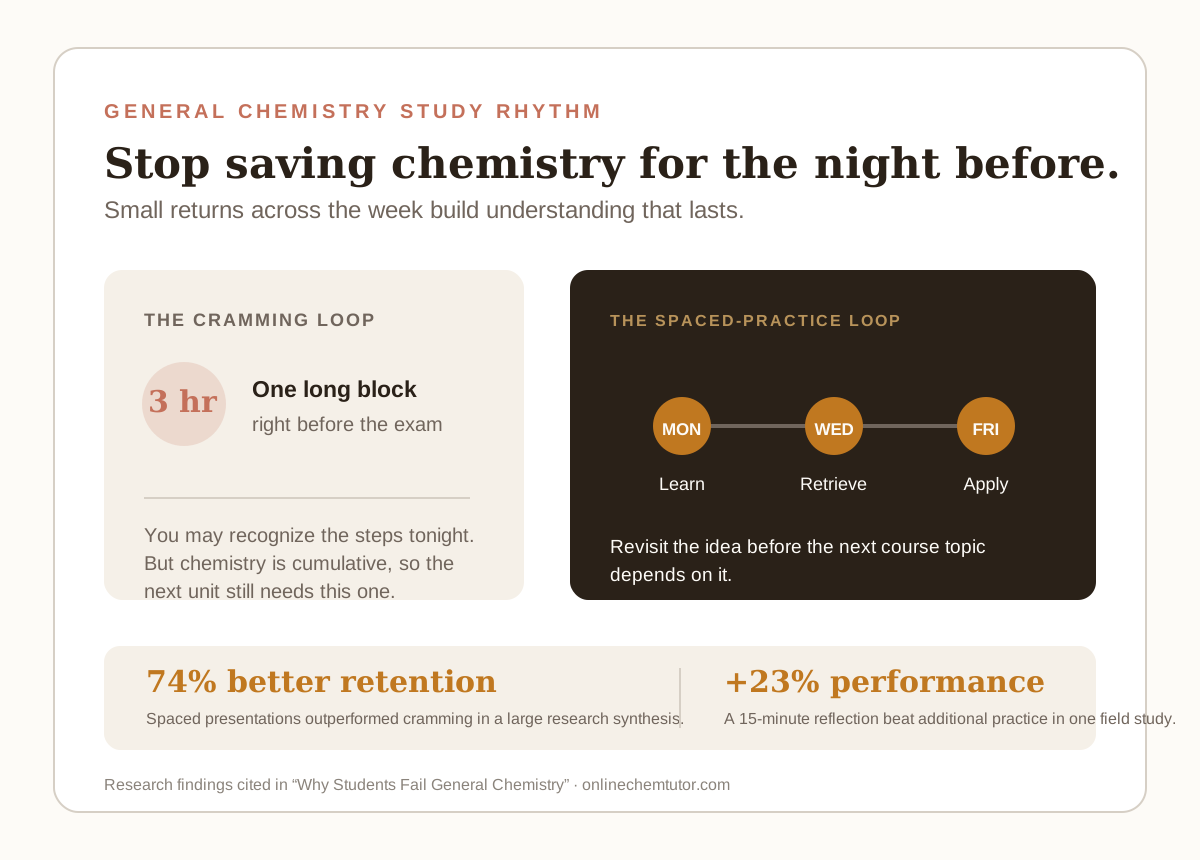
On the cramming question specifically: Cepeda and colleagues (2006), in a meta-analysis synthesizing 839 assessments from 317 experiments, found that spaced presentations of material produced approximately 74% better retention than massed (crammed) presentations — across retention intervals ranging from under one minute to over thirty days. Only 4.4% of comparisons favored massing over spacing.[4]
Applied to chemistry: a student who reviews stoichiometry for three hours the night before an exam will, on average, retain significantly less of it by the following week than a student who spends one hour on it on Monday, revisits it briefly on Wednesday, and works two new problems on Friday. The total time is similar. The retention is not.
This is especially important for chemistry because the course is cumulative. Unit 4 (reactions and stoichiometry) shows up inside Unit 8 (acids and bases), which shows up inside Unit 7 (equilibrium), which shows up on the final exam. A student who crammed Unit 4 and then moved on has essentially lost it by the time they need it again — and in chemistry, you always need it again.
Rohrer and colleagues (2020), in a randomized controlled trial of interleaved math practice published in the Journal of Educational Psychology, demonstrated that distributing homework problems across time — rather than blocking them by topic — produced significant benefits for both retention and transfer of knowledge.[5] The same principle applies directly to chemistry problem sets.
The Case for Weekly Review: What Happens When You Stop and Consolidate
One of the most underrated practices in a difficult course like general chemistry is a structured weekly review — not more studying, but a brief, deliberate look back at what the week covered before moving forward.
The research behind this comes from an unexpected place. Di Stefano, Gino, Pisano, and Staats (2014), in a field experiment at a business-process outsourcing firm, divided trainees into two groups during a training program: one group spent the final fifteen minutes of each training day doing more practice, while the other spent those same fifteen minutes writing a short reflection on what they had learned. On the final assessment, the reflection group outperformed the practice group by 23%.[6] Same hours. Same material. The only difference was that one group converted their experience into articulated understanding before the day ended.
The mechanism matters here. Raw experience — doing problems, reading notes, sitting through lecture — produces procedural memory. Reflection converts that experience into transferable principle: not just "I can do an ICE table" but "I understand why Q compared to K tells me which direction the reaction will shift." That second kind of knowing is what exam questions test.
Ebbinghaus's forgetting curve, documented in the 1880s and replicated consistently since, shows that without any review, students forget approximately 70% of new information within 24 hours. By the end of the week, retention can drop below 20%.[7] A weekly review session that revisits the week's material — even briefly — interrupts that decay at the right moment.
In practice, a weekly chemistry review doesn't need to be long. Thirty minutes on Saturday morning, structured around three questions:
- What concepts did I cover this week? Write them from memory before opening any notes. What you can recall without prompting is what you actually own. What you can't recall is your gap list.
- Where did I get stuck, and why? Not "I got question 3 wrong" — but what was the underlying concept that tripped you? Limiting reagent? The relationship between Ka and pKa? Name it specifically.
- What do I need to revisit before next week builds on it? Chemistry is cumulative. A gap in Week 3 becomes a wall in Week 6. Catch it now.
This is the structure I use in coaching sessions. The Saturday session isn't just another hour of practice — it's the consolidation pass that makes all the other hours stick.
What One-on-One Instruction Actually Does
In 1984, educational psychologist Benjamin Bloom at the University of Chicago published what became one of the most cited findings in education research. Bloom and his doctoral students compared three conditions: conventional classroom instruction (roughly 30 students per teacher), mastery learning, and one-on-one tutoring. The result was striking enough that it has its own name in the literature.
The average student who received one-on-one tutoring outperformed 98% of students in the conventional classroom — a two standard deviation difference (the "2 sigma" effect). About 90% of tutored students reached achievement levels that only the top 20% of conventionally taught students reached.[8]
Bloom's explanation was straightforward: one-on-one instruction allows the teacher to respond to exactly what the student doesn't understand, at exactly the moment they don't understand it. In a classroom of 30 students, a teacher moves at the pace of the curriculum. In a coaching session, the pace is the student's pace.
Nickow, Oreopoulos, and Quan (2020), in a systematic review and meta-analysis of 96 randomized controlled trials of tutoring programs published as an NBER Working Paper, found a pooled effect size of 0.37 standard deviations — a consistently large and positive impact on learning outcomes across tutor types, grade levels, and subjects.[9] In 93 of those 96 evaluations, tutoring led to improvements in learning.
For chemistry specifically, the one-on-one format matters for a reason that goes beyond pacing. Chemistry is a subject where a single misunderstanding — about what a mole represents, about what "equilibrium" actually means — can cascade through an entire semester. In a classroom, that misunderstanding might survive undetected for weeks. In a coaching session, it surfaces in the first conversation about the topic and gets corrected before it compounds.
The High-Stakes Problem: Test Anxiety Is Real, and It's Treatable
General chemistry — especially for pre-med, nursing, and pharmacy students — is a high-stakes course in a way that other courses are not. A poor grade doesn't just affect your GPA. It can close a door to a program you've been working toward for years. That reality produces anxiety, and anxiety in high-stakes testing contexts has a documented effect on performance.
Sena and colleagues found that test anxiety affects more than 33% of students.[10] Research by Cassady and Johnson (2002) found that high levels of test worry are associated with lower performance on standardized assessments, concluding that "cognitive test anxiety exerts a significant, stable, and negative impact on academic performance measures."[11]
What's interesting — and practically useful — is research by Beilock and colleagues (2011) at the University of Chicago, published in Science. They found that students prone to test anxiety who spent just 10 minutes writing about their worries before a high-stakes exam scored significantly better than anxious students who didn't. In ninth-grade biology students, highly anxious students who wrote before the exam received an average grade of B+, compared to a B– for highly anxious students who didn't. Writing "leveled the playing field" between high-anxiety and low-anxiety students.[12]
The mechanism the researchers proposed: writing offloads the cognitive burden of the anxiety, freeing up working memory for the actual exam. Worry occupies mental bandwidth. Getting it onto paper removes it from the processing space you need.
This is relevant to coaching in a specific way. A student who walks into an exam carrying three unresolved questions and two weeks of unreviewed material is carrying cognitive load that has nothing to do with their actual ability. Part of what weekly coaching sessions do — particularly the Saturday review rhythm — is reduce that load incrementally, week by week, so the student arrives at exam day without a backlog of uncertainty.
What This All Points Toward
The research isn't pointing toward any single silver bullet. It's pointing toward a system:
- Study to understand, not to execute. The computational–conceptual gap is real. Every time you finish a problem, ask what the numbers are actually representing at the molecular level. If you can't answer that, you haven't finished the problem.
- Spread practice across the week, not just before the exam. Forty-five minutes three times a week beats three hours the night before — not because of the total time, but because the spacing effect is real and chemistry is cumulative.
- Do a weekly consolidation pass. Thirty minutes on Saturday to recall what you learned, identify gaps, and plan what needs revisiting before the next week builds on it. This is where procedural knowledge becomes transferable understanding.
- Get feedback on your thinking, not just your answers. The 2 sigma effect exists because one-on-one instruction corrects misunderstandings at the moment they form. That's the difference between catching a conceptual error in Week 3 versus failing an exam in Week 10 because of it.
- Manage the high-stakes pressure deliberately. For pre-med and nursing students especially, the stakes are real — but anxiety that's carried unchecked into exam conditions directly reduces performance. A consistent weekly rhythm reduces the anxiety load before it accumulates.
I build all of this into the coaching model I use with students. The weekly Saturday session isn't just another tutoring hour — it's the consolidation pass, the gap audit, and the reset before the next week builds. That rhythm is why semester-long coaching produces different results than one-off sessions the week before an exam.
If this is the semester where general chemistry matters — for your degree, your program, your career path — the free 15-minute call is the place to start. I'll tell you honestly whether we're a good fit.
References
- Wolfer, A. J., & Lederman, N. G. (2000). Introductory college chemistry students' understanding of stoichiometry: Connections between conceptual and computational understandings and instruction. Department of Chemistry, University of Kansas. ERIC Document ED440856.
- Gauchon, L., & Méheut, M. (2007). Learning about stoichiometry: From students' preconceptions to the concept of limiting reagent. Chemistry Education Research and Practice, 8(4), 362–375. Royal Society of Chemistry. https://doi.org/10.1039/B7RP90003H
- Dunlosky, J., Rawson, K. A., Marsh, E. J., Nathan, M. J., & Willingham, D. T. (2013). Improving students' learning with effective study techniques: A promising direction from cognitive and educational psychology. Psychological Science in the Public Interest, 14(1), 4–58. https://doi.org/10.1177/1529100612453266
- Cepeda, N. J., Pashler, H., Vul, E., Wixted, J. T., & Rohrer, D. (2006). Distributed practice in verbal recall tasks: A review and quantitative synthesis. Psychological Bulletin, 132(3), 354–380. https://doi.org/10.1037/0033-2909.132.3.354
- Rohrer, D., Dedrick, R. F., Hartwig, M. K., & Cheung, C.-N. (2020). A randomized controlled trial of interleaved mathematics practice. Journal of Educational Psychology, 112(1), 40–52. https://doi.org/10.1037/edu0000435
- Di Stefano, G., Gino, F., Pisano, G. P., & Staats, B. R. (2014). Learning by thinking: How reflection aids performance. Harvard Business School Working Paper 14-093. https://doi.org/10.2139/ssrn.2414478
- Ebbinghaus, H. (1885/1913). Memory: A contribution to experimental psychology (H. A. Ruger & C. E. Bussenius, Trans.). Teachers College, Columbia University. (Original work published 1885.)
- Bloom, B. S. (1984). The 2 sigma problem: The search for methods of group instruction as effective as one-to-one tutoring. Educational Researcher, 13(6), 4–16. https://doi.org/10.3102/0013189X013006004
- Nickow, A. J., Oreopoulos, P., & Quan, V. (2020). The impressive effects of tutoring on PreK–12 learning: A systematic review and meta-analysis of the experimental evidence. NBER Working Paper No. 27476. National Bureau of Economic Research. https://doi.org/10.3386/w27476
- Sena, J. D. W., Lowe, P. A., & Lee, S. W. (2007). Significant predictors of test anxiety among students with and without learning disabilities. Journal of Learning Disabilities, 40(4), 360–376. https://doi.org/10.1177/00222194070400040601
- Cassady, J. C., & Johnson, R. E. (2002). Cognitive test anxiety and academic performance. Contemporary Educational Psychology, 27(2), 270–295. https://doi.org/10.1006/ceps.2001.1094
- Ramirez, G., & Beilock, S. L. (2011). Writing about testing worries boosts exam performance in the classroom. Science, 331(6014), 211–213. https://doi.org/10.1126/science.1199427